


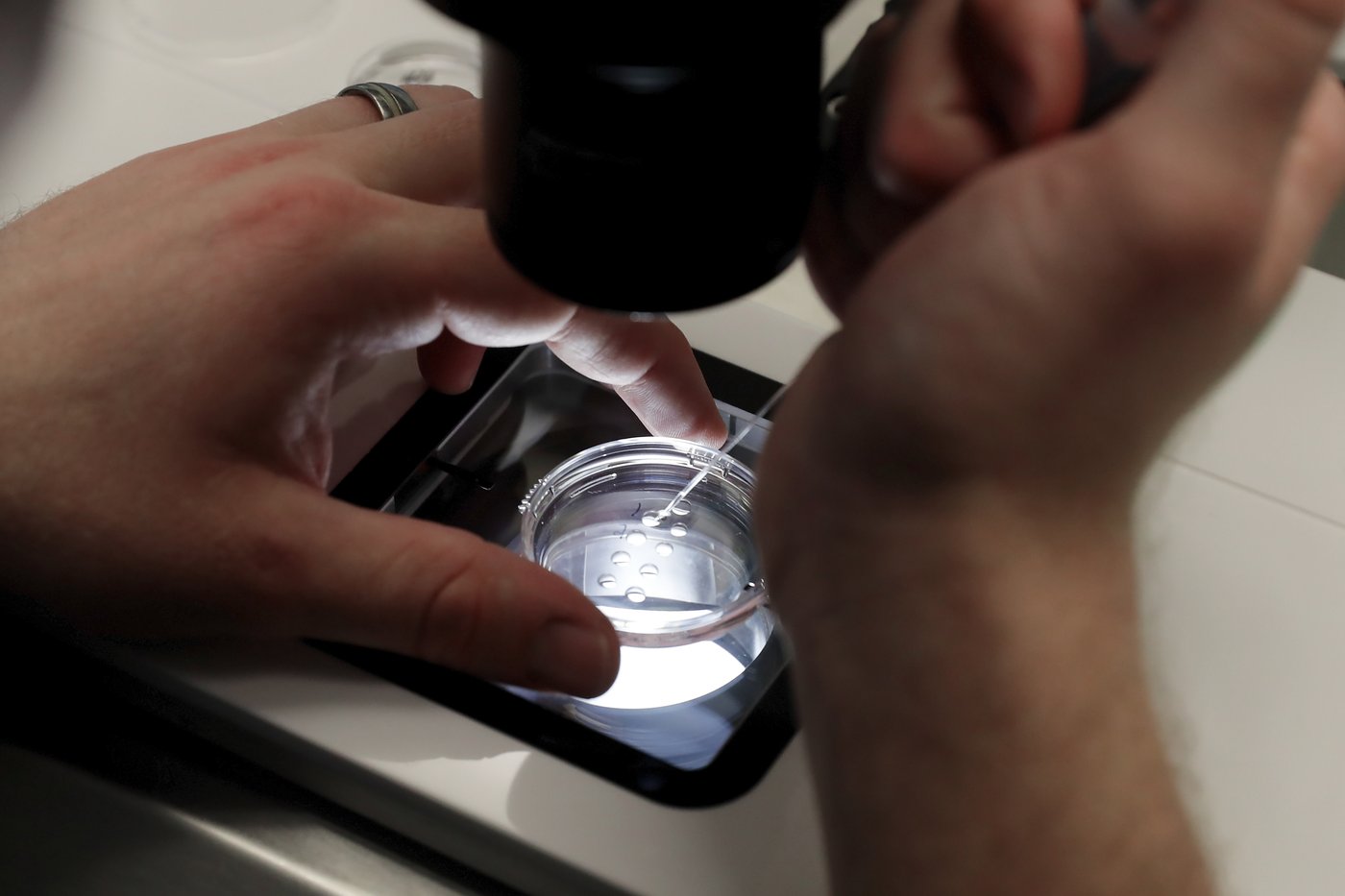
Clinical approval is not imminent, but a discovery by a team of researchers at McGill University could eventually allow women undergoing in vitro fertilization to avoid painful hormone injections and increase the procedure’s success rate.
This is the promising avenue of the light-activated microneedle patch. No more daily injections before egg retrieval for women hoping to get pregnant through in vitro fertilization. This step in the process is often stressful and painful for women.
In addition, in vitro fertilization is often unsuccessful. Success rates hover around 30 per cent, mainly because the injections must be given at specific times each day. “One of the problems with in vitro fertilization is that it often doesn’t work […] because it’s difficult to remember to inject yourself every day at the same time, and if you make mistakes in the timing of the injection, it can compromise the treatment,” explains Marta Cerruti, professor of materials engineering at McGill University and lead author of the study.
The innovation in this patch is that it allows the drug to be programmed to be injected at the desired time. For example, a woman receiving hormone injections could wear the patch on her skin, perhaps for a week, during which time the injections would be administered automatically at the same time each day.
Specifically, the patch is composed of hydrogel microneedles filled with nanoparticles, which, when stimulated by infrared light, release leuprolide, a key hormone for in vitro fertilization.
Beneficial for other diseases
It should be noted that the light-triggered microneedle patch is not a new technology. The innovative aspect lies in the fact that this is the first time that a light-activated microneedle patch does not release any foreign substances into the body.
“In order to release a drug with light, we have to break the bonds in the matrix where the drug is contained. The only light we can use to break these bonds is ultraviolet light,” explains Cerruti. However, we know that ultraviolet (UV) light is carcinogenic and should be avoided as much as possible.
“What we did was put very special nanoparticles into the stamp that are capable of transforming infrared light into ultraviolet light,” explains the researcher.
Her goal was to use these nanoparticles, but without releasing them into the body, as they could be harmful. “With this idea of microneedle technology, we put them in a matrix with microneedles that prevent the nanoparticles from passing into the body. Only the drug is released by the particles with infrared light,” she said.
For now, tests have been conducted on rats. Before moving on to clinical trials on humans, further tests on larger animals must be conducted. It could therefore take several more years before Health Canada evaluates the device and decides whether or not to approve it.
Ultimately, the technology could be useful for other health conditions, such as diabetes or multiple sclerosis.
Cerruti’s study was published in the scientific journal Small, with contributions from Vivienne Tam, Rusvir Trana, Alfonso Nieto-Arguello, Ore-Oluwa Olasubulumi, Samuel Babity, Artiom Skripka, Fiorenzo Vetrone, and Davide Brambilla.
—
The Canadian Press’s health coverage is supported by a partnership with the Canadian Medical Association. The Canadian Press is solely responsible for this journalistic content.
–This report by La Presse Canadienne was translated by CityNews
